

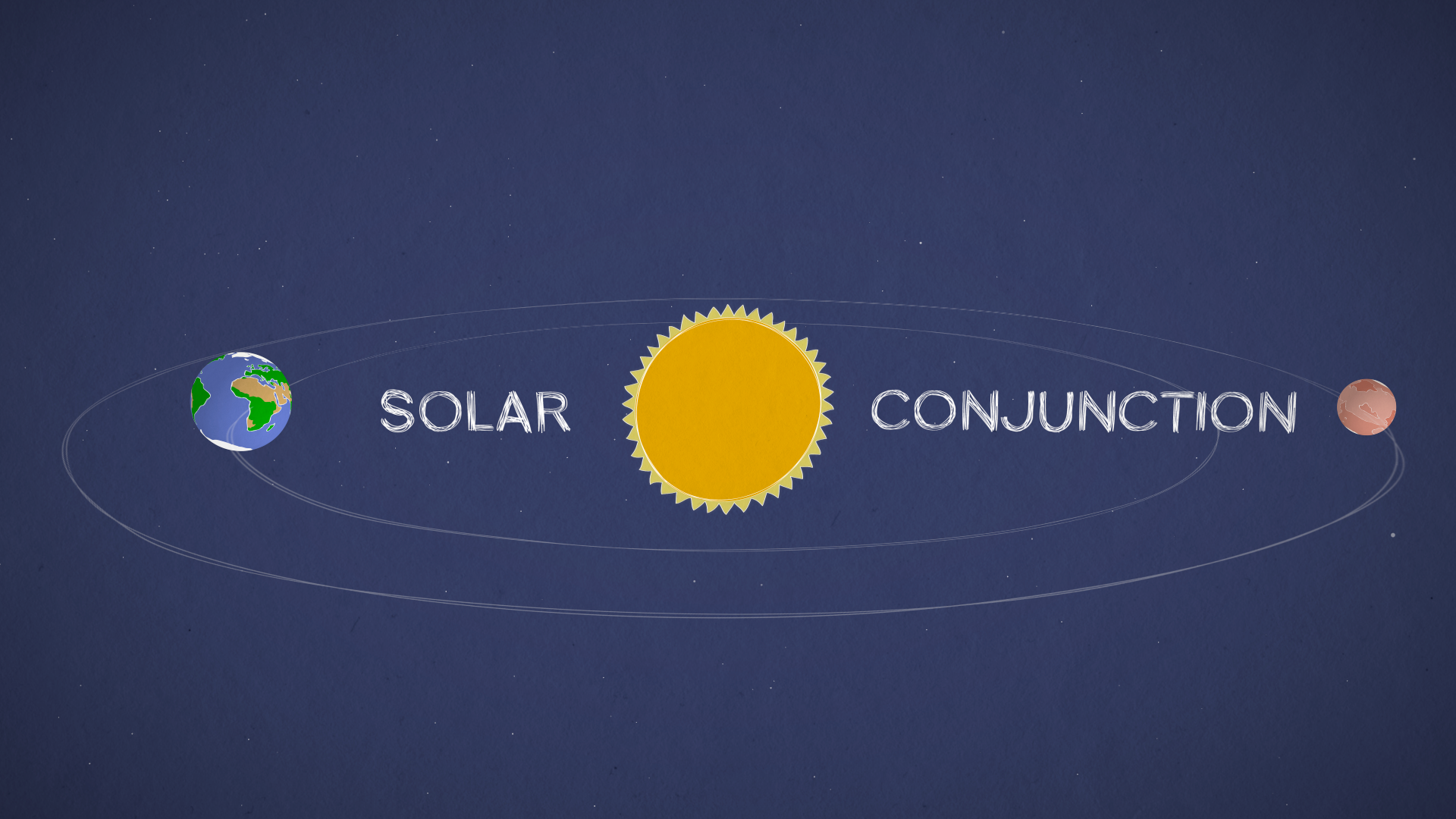
How can you communicate with Mars spacecraft when the Sun is in the way? Learn more about ‘solar conjunction’ in this 60-second video.
TRANSCRIPT
About every two years, Earth and Mars wind up on opposite sides of the sun. Thatʼs called “solar conjunction.”
It’s like being on either side of a huge bonfire: we canʼt see Mars, and our landers, rovers, and orbiters canʼt see us.
If our spacecraft send back signals, charged particles from the sun could interfere, causing gaps in the data that reach us.
Thatʼs not a big deal: if somethingʼs missing, it can always be resent later. But, no way do we want to lose data when we send up commands. Receiving a partial command could confuse the spacecraft, putting them in grave danger!
So, mission controllers plan ahead by sending up simple to-do lists, including regular health check ups.
Back home, this break in communications lets team members catch up on other work… or take a well-deserved vacation!
Solar conjunction lasts just a few weeks. Then itʼs back to the grindstone… on Earth and on Mars.
Why are the moon as mirror and better transmission protection algorithms no sufficient ways?
Why are the moon as mirror and better transmission protection algorithms no sufficient ways?
I don’t believe the moon is far away from Earth to act as a reliable relay for Mars - Earth communications.

A number of relay satellites could be parked at different Lagrange points (see attached image), but the cost of such a system would probably not be approved for robotic mission, as all space fairing nations have limited budgets, and robotic missions can just be paused for a few weeks during conjunction.
If extended crewed missions to Mars become a reality, I would think it would be essential to have such a communication system in place if the missions were planned to occur during a Mars-Earth solar conjunction.
You can read one assessment of different relay network topologies to improve Earth–Mars communications on this link - https://www.sciencedirect.com/science/article/pii/S0094576523000516
(The diagram in this reply is copied from the above link)
