

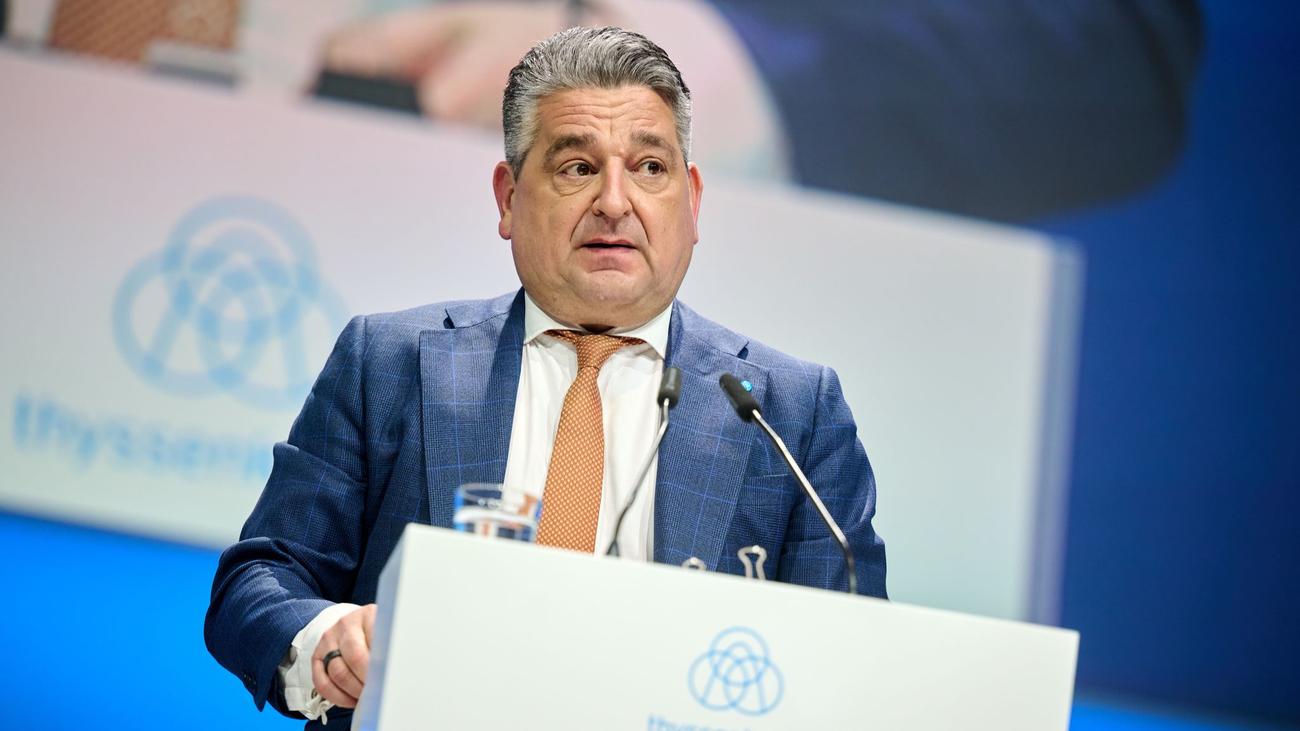
At the 27th ordinary annual general meeting in Bochum on Friday, Thyssenkrupp CEO Miguel López advocated for a fundamental transformation of the traditional conglomerate. The CEO announced that the company will shift from an integrated industrial group to a financial holding company. At the same time, several hundred employees demonstrated outside the RuhrCongress against the proposed dividend payout of 93 million euros.
“For a long time, Thyssenkrupp was run as an integrated industrial group,” López told approximately 500 shareholders. “In the future, Thyssenkrupp AG will be a financial holding company—an investment company that primarily holds majority stakes in strong, independent businesses under one roof.” The new strategy is called “ACES 2030” and provides for the gradual spin-off of all five business divisions – naval shipbuilding, steel, automotive parts, materials, and green technologies. This means “more flexibility, more speed, and direct access to the capital markets,” López explained. “This unlocks value that has been hidden within the company until now.”
The naval division TKMS was already taken public in October 2025 and has been listed on the MDAX since December. Talks are currently underway with Indian conglomerate Jindal Steel regarding a possible acquisition of the steel segment. “We are in constructive dialogue with Jindal Steel,” López said, without providing further details. The company employs just over 93,000 people
IG Metall and several hundred employees called on shareholders to forgo the planned dividend of 15 cents per share. “Shareholders already profited extraordinarily after the recent IPO of the Marine division. Paying out a dividend from the company’s capital reserves now would be economically wrong and send a disastrous signal,” read a union leaflet.
Ingo Speich from the fund management company Deka Investment also criticized the payout: “Paying a dividend comes at the expense of the company’s capital reserves. Thyssenkrupp has been living off its substance for years. This finally has to stop.”
Shareholder representatives nevertheless expressed cautious optimism about the course being taken. “Confidence is back, optimism has returned,” said Oliver Vollbrecht of the German Association for the Protection of Securities Holders. Speich also called for the divestment process to move forward: “We want a lean business model and the disposal of additional holdings in the foreseeable future.”
Employees of the Duisburg-based steel manufacturer HKM also participated in the demonstration outside the hall. “We finally want a collective social agreement,” said works council chairman Marco Gasse.