. . . Desert doesn’t advocate for primitivism or accelerationism? No offence, but it’s clear you’ve not read it.
There is no primitivism, the world is too damaged for such a life and there is no accelerating what it already happening. If anything it argues for the slow crash, where humans desperately clutch at survival and try to hold onto normal as long as possible.
Desert is about what happens during and after ecological collapse from climate change. It’s about the formation of hubs of holdout and people living in the edges of authority and dead ecology.
It’s about understanding that there is no global revolution to save us, that we won’t invent the super technology to undo the damage, and instead gives a hypothetical look at how people might survive and adapt to a new world from an anarchist and historical perspective.
… Desert doesn’t advocate for primitivism or accelerationism? No offence, but it’s clear you’ve not read it.
Man, I can literally quote Desert on both points.
There is no primitivism, the world is too damaged for such a life
A major point of several chapters in Desert is that primitivism is desirable because it prevent states, and inevitable because of the climate crisis.
and there is no accelerating what it already happening.
That… that is literally the point of acceleration. To make something that is already happening go faster.
The book literally advocates for rolling back environmental protections.
It’s about understanding that there is no global revolution to save us, that we won’t invent the super technology to undo the damage, and instead gives a hypothetical look at how people might survive and adapt to a new world from an anarchist and historical perspective.
It does more than propose a hypothetical, it also moralizes and advocates for surrender to the inevitable.


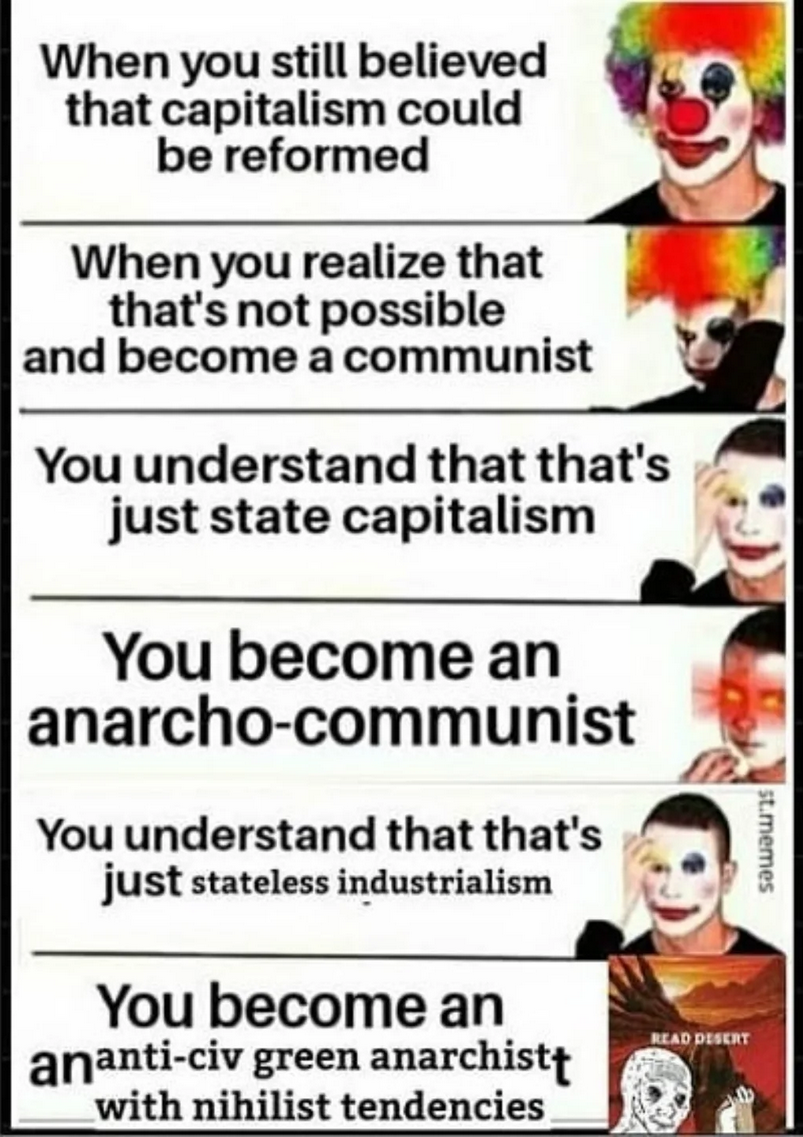
. . . Desert doesn’t advocate for primitivism or accelerationism? No offence, but it’s clear you’ve not read it.
There is no primitivism, the world is too damaged for such a life and there is no accelerating what it already happening. If anything it argues for the slow crash, where humans desperately clutch at survival and try to hold onto normal as long as possible.
Desert is about what happens during and after ecological collapse from climate change. It’s about the formation of hubs of holdout and people living in the edges of authority and dead ecology.
It’s about understanding that there is no global revolution to save us, that we won’t invent the super technology to undo the damage, and instead gives a hypothetical look at how people might survive and adapt to a new world from an anarchist and historical perspective.
Man, I can literally quote Desert on both points.
A major point of several chapters in Desert is that primitivism is desirable because it prevent states, and inevitable because of the climate crisis.
That… that is literally the point of acceleration. To make something that is already happening go faster.
The book literally advocates for rolling back environmental protections.
It does more than propose a hypothetical, it also moralizes and advocates for surrender to the inevitable.