
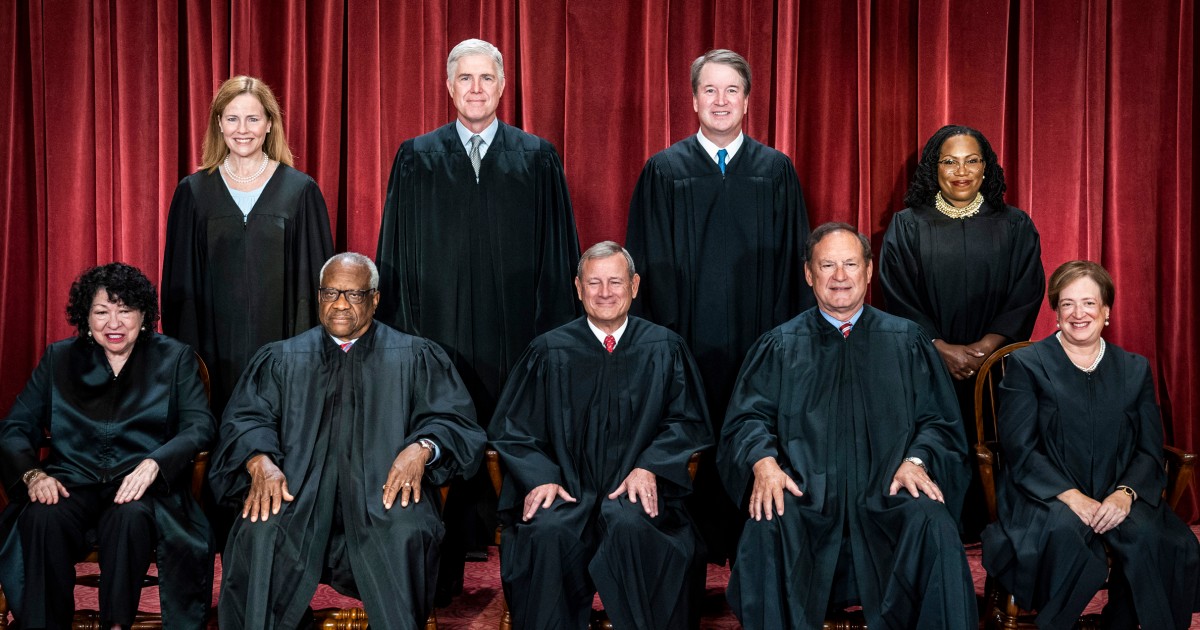
The Republican-led resolution, which requires two-thirds support in the House and the Senate, is a response to increasing openness among Democrats to expand the court.
A party that was confident about winning the midterms wouldn’t bother with proposing such an amendment. It’s good to see them sweat a bit.
We are going to stack that court get ready for it MAGAts.
Unfortunately, I’ll only believe it when I see it.
One could hope… Though I doubt it with the current party leadership. So far the most Schumer or Jeffries has had to say about reforming the Supreme Court is 18 year term limits.
I don’t know if the current DNC leadership has enough spine to actually implement an expansion.
The lengths of time we’ve gone without expanding the Supreme Court and without adding any new states to the union are both the longest in US history. We are long overdue for both.
And the House of Representatives.
Don’t talk about adding states… they’ll think you mean Greenland and Canada instead of Puerto Rico, American Samoa, etc.
A while ago I’d written a proposal for how the Supreme Court could be reformed. That was still under the presumption of a parliamentary system, rather than an anarchist/council communist or democratic socialist system, though, but still. It does highlight that the court is way too small for how many it represents.
The US. Supreme Court of Justice is appointed not by any political leader.
Instead, the court shall be apolitically appointed through multiple random ballots, out of a pool of all federal judges, whereas the latter shall be appointed by the same method, through a pool of all in their area, who have passed juridical examination.
The court itself shall be expanded as following: 𝐶 = 0.075 ∗ 3sqr(𝑈𝑆 𝑝𝑜𝑝𝑢𝑙𝑎𝑐𝑒)+ 2
where C is the court size, rounded to the closest full number, thus, 54 judges (2020). This method can be applied to more countries; for example, in 2024, India would then have 86, the Netherlands 22, and Vatican City 3. Ideally though, that would be the closest full (and uneven) number, so no ties can be made.