It’s more that all the interesting things that come from prime numbers don’t really work if you include 1 as a prime. So every time you talked about primes you would have to say “something something prime number, other than 1, yadda yadda”.
For example: The Fundamental Theorem of Arithmetic states that every natural number can be expressed as a finite product of primes, and that prime factorization is unique.
So
12 = 2^2 x 3
is the only way to express 12 as a product of primes. But if we include 1 as a prime, then
12 = 1 x 2^2 x 3
    = 1^2 x 2^2 x 3
    = 1^3 x 2^2 x 3
etc. There are infinite prime factorization of every natural number, and the most interesting part of the Fundamental Theorem of Arithmetic no longer holds.
It is actually more useful for 1 to not be considered prime in terms of application of the concept, as the other comments mentioned. Of course it’s artificial, all of math is. But the artificial definitions in science only stay in place if they’re actually useful.
I also always loved Xeno’s paradox … specifically the Dichotomy Paradox (Halving): To travel from point A to point B, you must first reach the halfway point, but before you reach that halfway point, you reach the halfway point of those two points and on and on and on into infinity … which suggests that in order to get from any point A to any point B, you have to cross infinity … but it’s impossible to travel to infinity so the suggestion of the paradox is that you should never be able to reach any point B
I don’t think I get it, the conclusion doesn’t make any sense to me at all
Because yes, there is an infinite amount of infinities when you think of decimals. We have two when it comes to integers - negative infinity and positive infinity, and there is an infinite amount of infinities between any two integers. 0 - 1, but also between decimals 0.1-0.2, etc
That doesn’t mean you can’t add or multiply any two numbers just because there is an infinity inbetween.
Imagine a distance of any length. How long does it take to cross an infinite number of that length? It takes an infinite amount of time.
Divide the length between A and B an infinite number of times. We now have an infinite number of lengths, which means it will take an infinite amount of time to cross them.
Which means nothing ever actually moves and movement itself is an illusion.
But that distance is also infinitesimally small, or put mathematically. If “any length” is L, it is L/inf. Cross that distance an infinite number of times, you get L/inf. * inf. By basic rules of fractions, these infinities cancel out.
I’m no maths wiz, but I’d say poof goes the paradox.
I think the issue is purely semantical and if we had a way to discriminate between the ultimate infinity from the subinfinities, the whole paradox would become completely irrelevant
It’s an interesting exploit of not having that distinction though
Well, this Zeno guy was an ancient philosopher who existed long long ago.
A “series” is the summation of all the terms in a sequence. In the modern day, we now know that an infinite geometric series, where there is a common ratio r, can be finite if the absolute value of r is less than 1! There’s a neat bit of maths behind that proof too.*
So in the case of Zeno’s paradox, it’s an infinite geometric series with r = 1/2. So if you had a distance of 1 metre, the next ones are 0.5m, 0.25m, etc. Each term is half of the previous. And since the absolute value of r is less than zero, the sum of the infinite series is finite, in this case it’s simply 2.
Infinity is a little weird.
*See replies below if you want to see my attempt at conveying it within the confines of an internet comment
Trying to do a math proof in a comment is hard, but I’ll try my best:
A term in a geometric series is defined as: u =ar^n-1
where a is the first term and r is the common ratio (the multiplier you use to get the next term)
so the sequence is a, ar, ar^2, … , ar^(n-1) where n is the number of terms in the sequence.
The sum of all the terms in a sequence, the geometric series, can be found using this for (absolute) values of r that are below 1:
Sn = a(1 - r^n) / (1 - r)
for (absolute) values of r above 1, it looks like this:
Sn = a(r^n - 1) / (r - 1)
But both equations will work with any value of r, they are just rearranged to make the maths easier. Where n is the number of terms in the series. For example, the series 2, 4, 8, 16 has four terms, the common ratio of 2 and a first term of 2. This means:
Sn = 2(2^4 - 1) / (2 - 1)
= 2(16 - 1) / 1
= 2 * 15
= 30
And if you check 2 + 4 + 8 + 16, you will find that it correctly equals 30, meaning the maths is right! In this case, it would be easier to add them up individually, but using the formula is useful when you have a large series with many different terms or when you have limited information (i.e. you are not given every individual term)
If you’re wondering how you get the proof for finding Sn, that’s something that I think is very difficult to cover in a small internet comment. You really need some good pencil and paper to illustrate how it works.
But in a nutshell, you can list down all the terms:
Sn = a, ar, ar^2, … , ar^(n-2), ar^(n-1)
Then, you write down rSn (common ratio multiplied by Sn), so you get:
rSn = ar, ar^2, a^3, … , ar^(n-1), ar^n
Then you subtract rSn from Sn, and you can see that a lot of it cancels out [ ar, ar^2, … , ar^(n-1) ]
It’s a little hard to show in text form, but it makes more sense once you write it down. This leaves you with this:
Sn - rSn = a - ar^n
Sn(1 - r) = a(1 - r^n)
Then you divide by (1 - r) to get a simplified expression for Sn!
Sn = a(1 - r^n) / (1 - r)
And for the other equation (where absolute value of r > 1), you instead subtract Sn from rSn, then divide by (r - 1) instead of (1 - r). It’s the same logic though.
And for an infinite series where | r | < 1 (absolute value of r is less than one), you can get a finite value. But how can this be? Let’s look back at this equation.
Sn = a(1 - r^n) / (1 - r)
When n tends towards infinity, it becomes very big. And since r is very small, r^n tends towards zero. You can try it out for yourself, typing a positive number less than 1 to the power of a really big number nets you a very very small number. As n becomes closer to infinity, r^n becomes closer to 0. So we can substitute r^n with zero like this:
Sn = a(1 - 0) / (1 - r)
= a / (1 - r)
And since this both a, the first term, and r, the common ratio, is finite, Sn must also be finite! And to go back to Zeno’s paradox. Let’s say a = 1 and r = 1/2. This means:
Sn = 1 / (1 - r)
= 1 / (1 - 0.5)
= 1 / 0.5
= 2
You find that Sn is the finite value 2. Maths is cool!
This, however, does not work if the absolute value of r is greater than or equal to one. The sum of all terms for such a geometric sequence would not be finite. (think 2 + 4 + 8 + …, the total sum is infinite as r = 2)


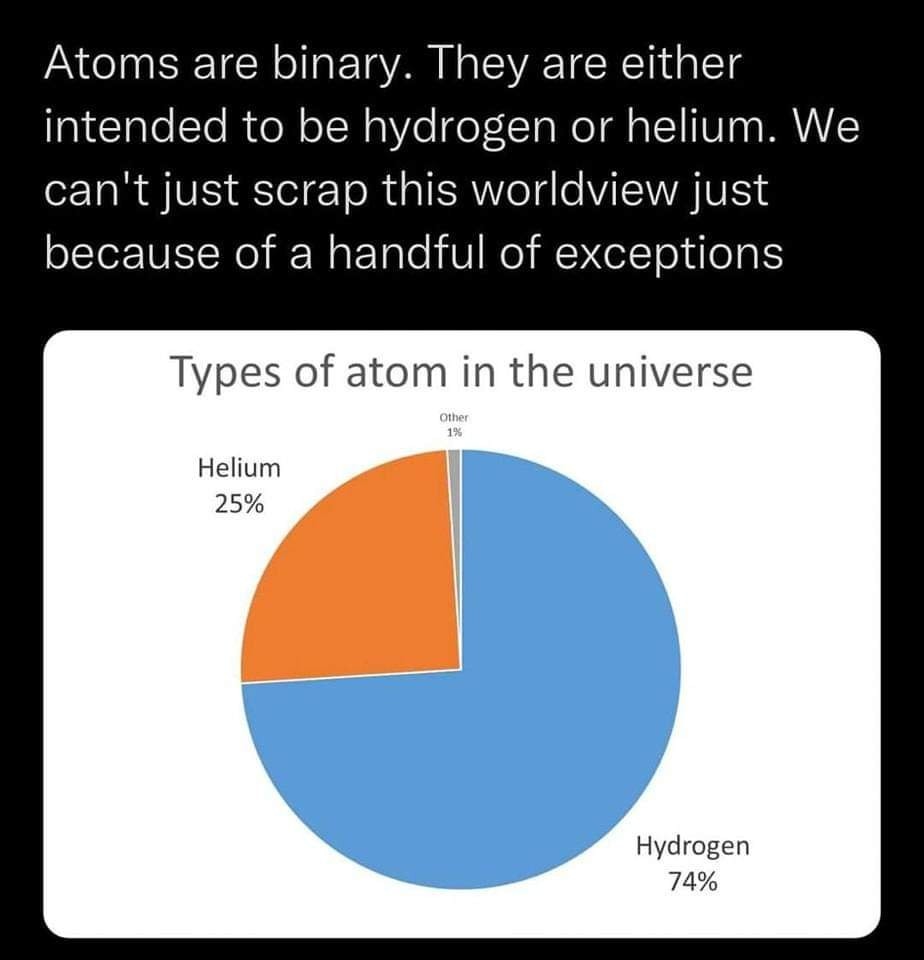
@PugJesus reminds me of the physics proof that all odd numbers are prime
1 is odd and prime
3, ditto
5, ditto
7, ditto
9, experimental error
11, ditto
.
.
.
The funniest part about this is 1 isn’t even prime.
That’s always irked me. I get that one is very very special.
It’s probably because I learned that a prime only “has factors of one and itself”… rather than “exactly two unique factors” per se.
It’s more that all the interesting things that come from prime numbers don’t really work if you include 1 as a prime. So every time you talked about primes you would have to say “something something prime number, other than 1, yadda yadda”.
For example: The Fundamental Theorem of Arithmetic states that every natural number can be expressed as a finite product of primes, and that prime factorization is unique.
So
is the only way to express 12 as a product of primes. But if we include 1 as a prime, then
etc. There are infinite prime factorization of every natural number, and the most interesting part of the Fundamental Theorem of Arithmetic no longer holds.
That… helped! :-)
TYVM for explaining that!
Prime is just a artifical restriction, like, a blue sky is only a sky if it’s blue.
1 / 2 is 0.5, a half. Nothing special about it.
It is actually more useful for 1 to not be considered prime in terms of application of the concept, as the other comments mentioned. Of course it’s artificial, all of math is. But the artificial definitions in science only stay in place if they’re actually useful.
If you wrote an algorithm that just outputs yes for all youd be 94% correct
AI is about 60-90% correct for comparison
I also always loved Xeno’s paradox … specifically the Dichotomy Paradox (Halving): To travel from point A to point B, you must first reach the halfway point, but before you reach that halfway point, you reach the halfway point of those two points and on and on and on into infinity … which suggests that in order to get from any point A to any point B, you have to cross infinity … but it’s impossible to travel to infinity so the suggestion of the paradox is that you should never be able to reach any point B
We cross infinity all the time. Git gud
… to infinity … and beyond
and you don’t fly there either … you’re just falling with style
I don’t think I get it, the conclusion doesn’t make any sense to me at all
Because yes, there is an infinite amount of infinities when you think of decimals. We have two when it comes to integers - negative infinity and positive infinity, and there is an infinite amount of infinities between any two integers. 0 - 1, but also between decimals 0.1-0.2, etc
That doesn’t mean you can’t add or multiply any two numbers just because there is an infinity inbetween.
Imagine a distance of any length. How long does it take to cross an infinite number of that length? It takes an infinite amount of time.
Divide the length between A and B an infinite number of times. We now have an infinite number of lengths, which means it will take an infinite amount of time to cross them.
Which means nothing ever actually moves and movement itself is an illusion.
But that distance is also infinitesimally small, or put mathematically. If “any length” is L, it is L/inf. Cross that distance an infinite number of times, you get L/inf. * inf. By basic rules of fractions, these infinities cancel out.
I’m no maths wiz, but I’d say poof goes the paradox.
I think the issue is purely semantical and if we had a way to discriminate between the ultimate infinity from the subinfinities, the whole paradox would become completely irrelevant
It’s an interesting exploit of not having that distinction though
I was told by a philosophy professor that to understand the paradox, I should read Wittgenstein. I couldn’t figure out Wittgenstein.
Well, this Zeno guy was an ancient philosopher who existed long long ago.
A “series” is the summation of all the terms in a sequence. In the modern day, we now know that an infinite geometric series, where there is a common ratio r, can be finite if the absolute value of r is less than 1! There’s a neat bit of maths behind that proof too.*
So in the case of Zeno’s paradox, it’s an infinite geometric series with r = 1/2. So if you had a distance of 1 metre, the next ones are 0.5m, 0.25m, etc. Each term is half of the previous. And since the absolute value of r is less than zero, the sum of the infinite series is finite, in this case it’s simply 2.
Infinity is a little weird.
*See replies below if you want to see my attempt at conveying it within the confines of an internet comment
Trying to do a math proof in a comment is hard, but I’ll try my best:
A term in a geometric series is defined as: u =ar^n-1
where a is the first term and r is the common ratio (the multiplier you use to get the next term)
so the sequence is a, ar, ar^2, … , ar^(n-1) where n is the number of terms in the sequence.
The sum of all the terms in a sequence, the geometric series, can be found using this for (absolute) values of r that are below 1:
Sn = a(1 - r^n) / (1 - r)
for (absolute) values of r above 1, it looks like this:
Sn = a(r^n - 1) / (r - 1)
But both equations will work with any value of r, they are just rearranged to make the maths easier. Where n is the number of terms in the series. For example, the series 2, 4, 8, 16 has four terms, the common ratio of 2 and a first term of 2. This means:
Sn = 2(2^4 - 1) / (2 - 1)
= 2(16 - 1) / 1
= 2 * 15
= 30
And if you check 2 + 4 + 8 + 16, you will find that it correctly equals 30, meaning the maths is right! In this case, it would be easier to add them up individually, but using the formula is useful when you have a large series with many different terms or when you have limited information (i.e. you are not given every individual term)
If you’re wondering how you get the proof for finding Sn, that’s something that I think is very difficult to cover in a small internet comment. You really need some good pencil and paper to illustrate how it works.
But in a nutshell, you can list down all the terms:
Sn = a, ar, ar^2, … , ar^(n-2), ar^(n-1)
Then, you write down rSn (common ratio multiplied by Sn), so you get:
rSn = ar, ar^2, a^3, … , ar^(n-1), ar^n
Then you subtract rSn from Sn, and you can see that a lot of it cancels out [ ar, ar^2, … , ar^(n-1) ]
It’s a little hard to show in text form, but it makes more sense once you write it down. This leaves you with this:
Sn - rSn = a - ar^n
Sn(1 - r) = a(1 - r^n)
Then you divide by (1 - r) to get a simplified expression for Sn!
Sn = a(1 - r^n) / (1 - r)
And for the other equation (where absolute value of r > 1), you instead subtract Sn from rSn, then divide by (r - 1) instead of (1 - r). It’s the same logic though.
And for an infinite series where | r | < 1 (absolute value of r is less than one), you can get a finite value. But how can this be? Let’s look back at this equation.
Sn = a(1 - r^n) / (1 - r)
When n tends towards infinity, it becomes very big. And since r is very small, r^n tends towards zero. You can try it out for yourself, typing a positive number less than 1 to the power of a really big number nets you a very very small number. As n becomes closer to infinity, r^n becomes closer to 0. So we can substitute r^n with zero like this:
Sn = a(1 - 0) / (1 - r)
= a / (1 - r)
And since this both a, the first term, and r, the common ratio, is finite, Sn must also be finite! And to go back to Zeno’s paradox. Let’s say a = 1 and r = 1/2. This means:
Sn = 1 / (1 - r)
= 1 / (1 - 0.5)
= 1 / 0.5
= 2
You find that Sn is the finite value 2. Maths is cool!
This, however, does not work if the absolute value of r is greater than or equal to one. The sum of all terms for such a geometric sequence would not be finite. (think 2 + 4 + 8 + …, the total sum is infinite as r = 2)
That’s the paradox and that’s why I love this thought experiment.
There is infinity in everything and everywhere … yet we are told that we can’t cross infinity … yet we do it all the time.
Zeno
This hinges on the assumption, that you have to partition your way infinitely, to reach point B.
Sounds like bull to me.