Most “good choices” and “bad choices” are fairly easy to figure out. Would you want this thing done to you? If no, then do not do that thing. That’s going to cover the vast majority of cases.
There are some exceptions. Sometimes one might need to balance the needs of the many against the needs of the few. Sometimes one might be presented with a set of all-bad options. Those situations are vanishingly rare, and usually limited to circumstances where group consensus can help one determine which choice is acceptable to the greatest number.
But it’s not always easy, and it’s not always clear. I actually had a version of this conversation at a wedding with a guy who had his master’s degree in philosophy and another guy who was a devout Christian who was suffering a profound crisis of faith because his toddler nephew had just died of a brain aneurism.
The crisis-experiencing Christian asked me “Isn’t it scary when there aren’t clear answers?”
And my answer was “Yes, frequently. I often wish that there was an obvious or comforting answer to the terrifying conundrums of reality. But there often isn’t, and it’s my job as an adult to figure out what to do in those situations. Work out the moral calculus of what kind of world I want to create, try to work towards that world, and try to cope when reality won’t cooperate in the ways that I wish it would.”
Sometimes it’s a cold universe out there, and you’ve got to build yourself a fire out of coherent philosophy to get through the night. Relying on dogma is a lot like a shot of brandy; it might make you feel warm for a while, but eventually the cold will get to you, and you’ve got to have that sustaining fire or else you’re going to freeze to death.


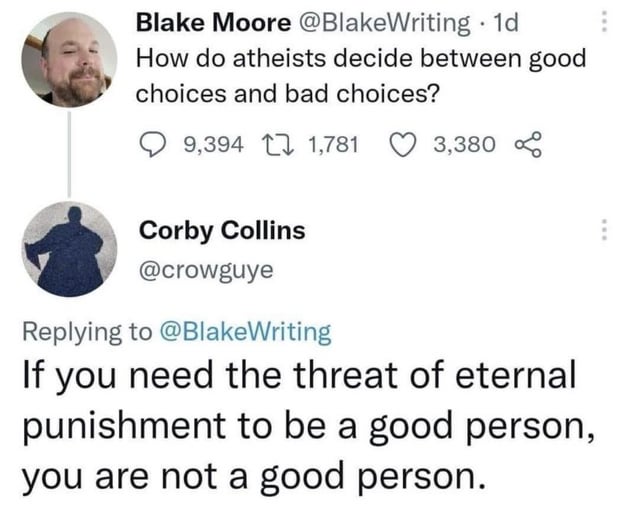
I’ll entertain the spirit of the question.
Most “good choices” and “bad choices” are fairly easy to figure out. Would you want this thing done to you? If no, then do not do that thing. That’s going to cover the vast majority of cases.
There are some exceptions. Sometimes one might need to balance the needs of the many against the needs of the few. Sometimes one might be presented with a set of all-bad options. Those situations are vanishingly rare, and usually limited to circumstances where group consensus can help one determine which choice is acceptable to the greatest number.
But it’s not always easy, and it’s not always clear. I actually had a version of this conversation at a wedding with a guy who had his master’s degree in philosophy and another guy who was a devout Christian who was suffering a profound crisis of faith because his toddler nephew had just died of a brain aneurism.
The crisis-experiencing Christian asked me “Isn’t it scary when there aren’t clear answers?”
And my answer was “Yes, frequently. I often wish that there was an obvious or comforting answer to the terrifying conundrums of reality. But there often isn’t, and it’s my job as an adult to figure out what to do in those situations. Work out the moral calculus of what kind of world I want to create, try to work towards that world, and try to cope when reality won’t cooperate in the ways that I wish it would.”
Sometimes it’s a cold universe out there, and you’ve got to build yourself a fire out of coherent philosophy to get through the night. Relying on dogma is a lot like a shot of brandy; it might make you feel warm for a while, but eventually the cold will get to you, and you’ve got to have that sustaining fire or else you’re going to freeze to death.