I agree with the first person about morality determining how to respond socially. For example, why is killing someone in self defense necessary? Why shouldn’t you just run? Responding to violence with violence could be bad if someone else thinks that you weren’t in enough legitimate danger. Similarly, is it ok to kill if you are protecting someone else? What if the person you were protecting did not feel that killing was necessary?
I don’t believe that you are picking up what I’m putting down. Why shouldn’t you die instead? Why do we consider it understandable to defend yourself to the death? Obviously it is because we value lives more than whatever the other person wants that drives them to attack someone, but there isn’t a strict reason for that beyond social acceptance. We could just as easy decide, as a society, that those who can’t defend themselves should be culled. Or that murder is so incomprehensible that there is no reason to consider it.
Murder and death are obviously extreme examples, but you work that idea forward to charity, politeness, and social contract to yield to a government authority.
I think we agree, we’re just coming at it from different places, and I was being quite vague at trying to play devil’s advocate.
In this hypothetical, one person makes it out alive and we have no other contextual info. There isn’t a moral value assigned to that event in a vacuum, because a biological imperative - the instinct to preserve one’s own life - both precedes and precludes morality.
In hindsight, we can apply our moral judgement and decide if that killing was “justified”, but it’s a messy, fraught process with mixed results and nothing gained. At the moment of one killing another, the killed is reduced to their biological imperative to stay alive. They do what any animal would do in that moment and, though we try, it’s futile to think we can consistently overlay morality on whatever outcome results.
In the spirit of the OP, there’s an argument to be made against killing which doesn’t invoke religious dogma or a higher power. You could say it’s wrong because to do so reduces the victim to their biological, physical animal core, and stripping their humanity is not just in itself wrong, it precludes the clean application of a moral judgement in the future.
Even in the case of killing someone we’ve decided is “bad”, no matter how bad the victim might have been, all of that falls away when they are threatened with inescapable death. So it’s not ever justified.
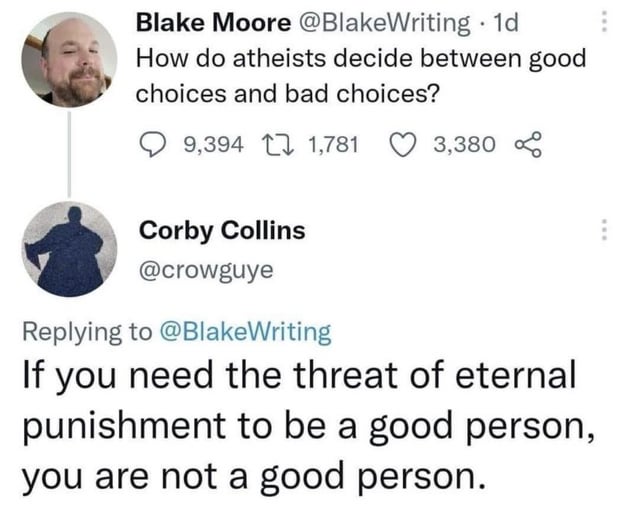
Regardless, ancient scripture is no foundation for morality. It’s simply what people came up with thousands of years ago before moral foundations got properly built. It took all that time to develop because tradition held humanity back.


We’re taking about morally good and bad here.
Killing people in self defense might be necessary, but that doesn’t make it good.
Killing people is morally bad, even if it’s someone no one in their right mind would hesitate to murder if given the opportunity, like Putin.
I agree with the first person about morality determining how to respond socially. For example, why is killing someone in self defense necessary? Why shouldn’t you just run? Responding to violence with violence could be bad if someone else thinks that you weren’t in enough legitimate danger. Similarly, is it ok to kill if you are protecting someone else? What if the person you were protecting did not feel that killing was necessary?
If it’s truly necessary, there’s no option to run - no alternatives - it’s your life or theirs.
I don’t believe that you are picking up what I’m putting down. Why shouldn’t you die instead? Why do we consider it understandable to defend yourself to the death? Obviously it is because we value lives more than whatever the other person wants that drives them to attack someone, but there isn’t a strict reason for that beyond social acceptance. We could just as easy decide, as a society, that those who can’t defend themselves should be culled. Or that murder is so incomprehensible that there is no reason to consider it.
Murder and death are obviously extreme examples, but you work that idea forward to charity, politeness, and social contract to yield to a government authority.
I think we agree, we’re just coming at it from different places, and I was being quite vague at trying to play devil’s advocate.
In this hypothetical, one person makes it out alive and we have no other contextual info. There isn’t a moral value assigned to that event in a vacuum, because a biological imperative - the instinct to preserve one’s own life - both precedes and precludes morality.
In hindsight, we can apply our moral judgement and decide if that killing was “justified”, but it’s a messy, fraught process with mixed results and nothing gained. At the moment of one killing another, the killed is reduced to their biological imperative to stay alive. They do what any animal would do in that moment and, though we try, it’s futile to think we can consistently overlay morality on whatever outcome results.
In the spirit of the OP, there’s an argument to be made against killing which doesn’t invoke religious dogma or a higher power. You could say it’s wrong because to do so reduces the victim to their biological, physical animal core, and stripping their humanity is not just in itself wrong, it precludes the clean application of a moral judgement in the future.
Even in the case of killing someone we’ve decided is “bad”, no matter how bad the victim might have been, all of that falls away when they are threatened with inescapable death. So it’s not ever justified.
Morality varies widely by individual and culture.
Pro-Life folks have been saying this for decades.
Ffs, Zionists have been saying this.
You need more than just platitudes to build a moral foundation
Regardless, ancient scripture is no foundation for morality. It’s simply what people came up with thousands of years ago before moral foundations got properly built. It took all that time to develop because tradition held humanity back.
By what standard?
Killing people is wrong. This is an immortal and unquestionable truth that everyone has always agreed upon
We didn’t have a proper moral foundation until very recently, so disregard everything older than several hundred years ago.
What?